Pinta
Mariners' Museum, Uncurated Search Results
Type: Bugeye
Year: 1883
Builder:
Location: Whitehaven

These records are found in the online catalog of The Mariners’ Museum and Park in Newport News, Virginia. Uncurated search results are presented to give researchers and interested readers an idea of whether the museum’s archives contain information about this vessel and whether it may be worthwhile to visit the museum’s catalog search page for further investigation. Uncurated results may be inaccurate or incomplete.
Search mode: Exact Name. Search phrase(s): "Pinta". Results returned: 34. Results displayed in this table: 34.
Use these buttons to send uncurated search results to your own app or text document for further research. First, check the box for any row, or click "Select All" then uncheck any rows. Then click "Show Selections". You can then copy your selections from the text box and past them into your app.
| Fetch? | Row ID | Media | Date | Vessel | Place | Related Places | Inscription/Marks | Subject | Notes | Archive Number |
|---|---|---|---|---|---|---|---|---|---|---|
| 1 | No image URL. | Pinta | P0001.011/01-2455 | |||||||
| 2 | 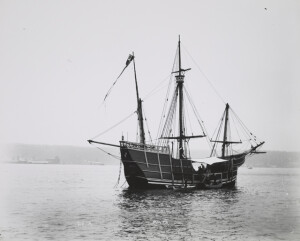 | on recto below image, 26-a, Pinta. on verso: E-6960; P.L. Sperr Collection from Frederic Lewis stamp. | Replica of the Spanish caravel Pinta in Hudson River. | P0002.001/02-003#006960 | ||||||
| 3 | No image URL. | SHORT DESCRIPTION: Glass plate with engraving in center of the PINTA. | CL4932 | |||||||
| 4 | No image URL. | Niña (Caravel).; Pinta (Caravel); Santa María (Caravel); Santa Clara (Caravel). | Anatomy of the ship | Sailing ships–History. Spain; Sailing ships–Pictorial works. | The ships of Christopher Columbus : __Santa Maria, Niäna, Pinta __Xavier Pastor | LB20317 | ||||
| 5 | 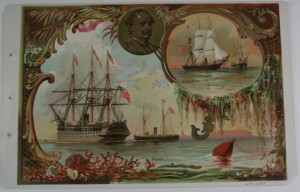 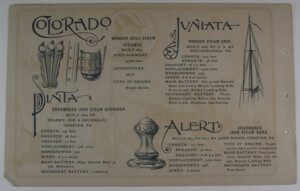 | SHORT DESCRIPTION: This chromolithograph shows USS Colorado and USS Pinta in calm waters. In the top right corner is an image of USS Juniata and USS Alert. To the left of that is an image of Admiral David Farragut from the shoulders up. On the reverse there is information about each ship with images of a capstan and other rigging. NOTES: This is one page of a bound set of 15 chromolithographs printed by Schumacher & Ettlinger of New York titled "Our Navy." They were printed for Allen & Ginter, cigarette manufacturers in Richmond, Virginia who began selling trading cards with their cigarette packages. This included sports figures, famous Americans, and this example about the U.S. Navy. This set is designated A22 in the American Card Catalog. For the bound set, see VA57 .O92 Rare in the Library. See LP 6281-LP 6295 for the complete series. NOTES: [from paper conservator, Emilie Duncan] I do think they are color lithographs. I think the characteristics Lindsey and I were seeing that were making us hesitate were caused by the way the ink sits on the clay-coated paper surface. I was curious about color lithograph vs. chromolithograph, and it looks like they are indeed the same thing, but chromolithograph is generally used when talking about mass-produced items or ephemera, while color or tinted lithograph is used for fine art pieces. Just thought I would pass that along in case it helps with the cataloging language. VESSEL INFORMATION - VESSEL NAME: COLORADO VESSEL TYPE: WOODEN HULL SCREW STEAMER VESSEL BUILT: 1855 DISPLACEMENT: 4700 VESSEL NAME: PINTA VESSEL TYPE: UNARMORED IRON STEAM SCHOONER VESSEL BUILT: 1865 SHIPBUILDER: REANEY, SON & ARCHBALD BUILDER LOCATION: CHESTER, PENNSYLVANIA VESSEL DIMENSIONS: 137' x 26' x 11', 306 tons VESSEL NAME: JUNIATA VESSEL TYPE: WOODEN STEAM SHIP VESSEL BUILT: 1862 VESSEL DIMENSIONS: 205 x 38 x 16-1/2, 1900 tons VESSEL NAME: ALERT VESSEL TYPE: UNARMORED IRON STEAM BARK VESSEL BUILT: 1873 to 1875 SHIPBUILDER: JOHN ROACH BUILDER LOCATION: CHESTER, PENNSYLVANIA VESSEL DIMENSIONS: 175' x 32' x 12-3/4', 1020 tons | CL9947 | |||||||
| 6 | 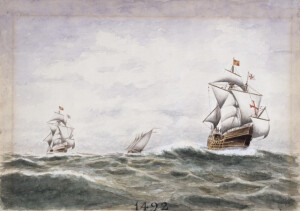 | SHORT DESCRIPTION: Watercolor drawing by Norfolk artist William Gardham Larmour of Columbus's ships the Santa Maria, Pinta and Nina. | CL6831 | |||||||
| 7 | 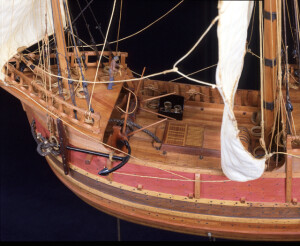 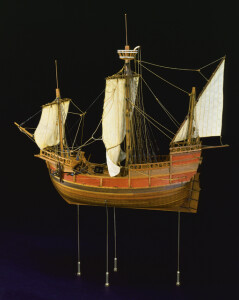 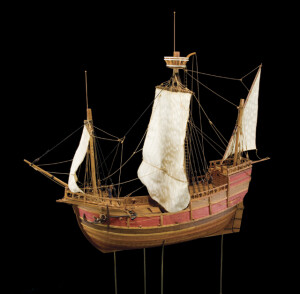 | NOTES: The Crabtree Collection at The Mariners' Museum consists of sixteen ship models (or "miniature ships," as Crabtree preferred to call them, all built between about 1925 and 1955. The Museum also houses a selection of his tools and samples of various materials and construction techniques, and some of his miniature carved busts. August Crabtree's work remains an inspiration to modelmakers after several generations, for its superb quality and general accuracy. While there are some minor errors of detail, it must be remembered that he did not have access to the many published sources which later modelmakers have enjoyed in great profusion. Mrs. Crabtree (Winnifred, with double "nn"), assisted with the sailmaking and painting of at least the later models. Dates of construction of most individual models have not been determined, so they are shown only within his known productive period. For additional details on the Crabtrees and their work, or on the individual vessels, see John A. Tilley, THE SHIP MODELS OF AUGUST F. CRABTREE (The Mariners' Museum, 1981 and 1991), and videotape, THE AUGUST F. CRABTREE COLLECTION OF MINIATURE SHIPS (The Mariners' Museum, 1996). ADDITIONAL INFORMATION: See object file for list of articles about August F. Crabtree and his models. MODEL NOTES: PINTA, along with NINA (not modeled by Crabtree, but see model # 1991.51.1, by Roger Hambidge) was a "caravela" (caravel), narrower, more graceful, and faster than SANTA MARIA, a "nao," or round ship. As with most of his models, Mr. Crabtree includes one or more figures on the deck for human interest and to illustrate the scale of the model. Hull is painted above the middele wale and natural wood below, both sides. VESSEL INFORMATION- VESSEL NAME: PINTA NATIONALITY: Spanish HOME PORT: Spain, Palos VESSEL TYPE: Caravel VESSEL DIMENSIONS: Hull about 70 feet SERVICE DATES: Late 15th century SHIPBUILDER LOCATION: Spain CAPTAINS OR OTHER RELATED PEOPLE: Columbus, Christopher (Colombo, Cristoforo) INVENTORY: base - there is one (1) component part. | CL24953 | |||||||
| 8 | No image URL. | Voyage of the discovery ships : the rebirth of the Nina, the Pinta, and the Santa Maria. | LB83635 | |||||||
| 9 | No image URL. | Santa María (Ship : Replica); Pinta (Caravel : Replica); Niña (Caravel : Replica).; Santa Clara (Caravel : Replica). | Biblioteca Quinto Centenario | La Santa María, la Pinta y la Niña __[autores, Guadalupe Chocano, Ignacio Fernández Vial, Consuelo Varela ; traducción al inglés, Paul A. Isbell] = __The Niña, the Pinta, and the Santa María / [authors, Guadalupe Chocano, Ignacio Fernández Vial, Consuelo Varela ; English translation, Paul A. Isbell] | LB794 | |||||
| 10 | No image URL. | Santa María (Ship); Niña (Caravel).; Pinta (Caravel); Santa Clara (Caravel). | Printed in the German Democratic Republic. | LB8536 | ||||||
| 11 | No image URL. | Niña (Caravel).; Santa Clara (Caravel).; Pinta (Caravel); Santa Clara (Caravel). | Caravels. | See also V.F.-Columbus, Christopher. | LB91083 | |||||
| 12 | 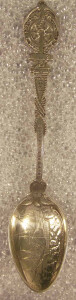 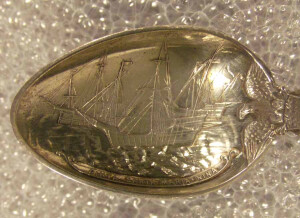 | SHORT DESCRIPTION: Obverse: In the bowl appear portraits of Columbus' caravels and the inscription: PINTA, SANTA MARIA, NINA. On the handle appears the American eagle and shield, a fouled anchor, steering wheel, capstan, and the inscription Columbus Caravels 1893. Reverse: Moore and Leding, Sterling. There is a mark that looks like a flower in front of the word sterling which indicates the spoon was made by Howard Sterling Company of Providence, Rhode Island. VESSEL INFORMATION - VESSEL NAME: SANTA MARIA VESSEL BUILT: SPAIN VESSEL DIMENSIONS: 74.2" (length), 25.7' (beam), 13.5 (depth), 200 tons. | CL714 | |||||||
| 13 | 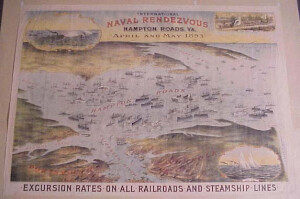 | LABEL COPY: After a rendezvous in Hampton Roads, Virginia, April 1893, ships from ten countries sailed to New York to participate in an international naval review. President Cleveland reviewed the fleet. The review was held in honor of the 400th anniversary of Christopher Columbus' voyage of discovery. For the occasion, replicas of Columbus's fleet: NINA, PINTA, and SANTA MARIA were constructed in Spain in 1892, and towed across the Atlantic. They were later exhibited at Chicago's Columbian Exposition. The countries taking part in the New York review were: Great Britain, France, Brazil, Russia, Italy, Germany, Holland, Spain, Argentina and the United States. ADDITIONAL INFORMATION: See Harper's Weekly, 1893. | CL8444 | |||||||
| 14 | 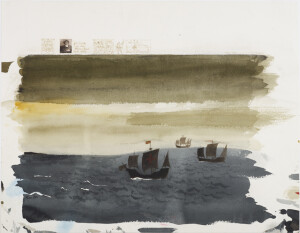 | SHORT DESCRIPTION: Watercolor on paper depicting Christopher Columbus's fleet, the Santa Maria, Nina and Pinta under sail at sea. At the top left the artist has drawn boxes contains outline-drawings of a crest, a scene of Columbus meeting Queen Isabella and King Ferdinand, a standing Spanish warrior, and a map of the West Indies. He has also drawn a small watercolor view of Christopher Columbus which appears to be based upon the posthumous portrait by Sebastiano del Piombo. | CL30287 | |||||||
| 15 | No image URL. | Hudson River (N.Y. and N.J.). | Warships–Visits to foreign ports.; Harbors–New York (State)–New York. | On April 27th, 1893, a fleet of warships representing the United States, Great Britain, Spain, Russia, France, Holland, Italy, Germany, Argentina and Brazil, and three Spanish caravels representing Columbus' ships, the "Nina," the "Pinta," and the "Santa Maria" participated in the Columbian naval review in New York Bay and Hudson River. On April 28, 1893, sailors and marines from the ships joined in a land parade from 42nd St. to City Hall. "Paper from Henry Lindenmeyer & Sons, New York." On cover: "Admiral" cigarettes. Illustrations and advertisements on p. [2]-[4] of cover. Illustration of The French cruiser "Jean Bart" signed A. Brun; engraved by Michelet. Ill. of the Italian cruiser "Dogali" signed John Swain. Advertisements throughout. | LB29085 | |||||
| 16 | 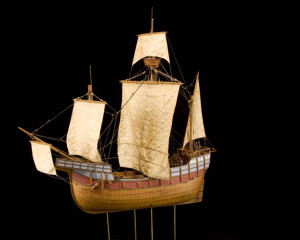 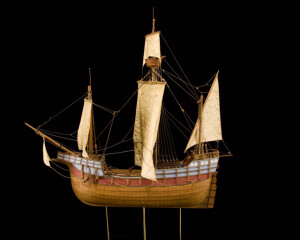 | NOTES: The Crabtree Collection at The Mariners' Museum consists of sixteen ship models (or "miniature ships," as Crabtree preferred to call them, all built between about 1925 and 1955. The Museum also houses a selection of his tools and samples of various materials and construction techniques, and some of his miniature carved busts. August Crabtree's work remains an inspiration to modelmakers after several generations, for its superb quality and general accuracy. While there are some minor errors of detail, it must be remembered that he did not have access to the many published sources which later modelmakers have enjoyed in great profusion. Mrs. Crabtree (Winnifred, with double "nn"), assisted with the sailmaking and painting of at least the later models. Dates of construction of most individual models have not been determined, so they are shown only within his known productive period. For additional details on the Crabtrees and their work, or on the individual vessels, see John A. Tilley, THE SHIP MODELS OF AUGUST F. CRABTREE (The Mariners' Museum, 1981 and 1991), and videotape, THE AUGUST F. CRABTREE COLLECTION OF MINIATURE SHIPS (The Mariners' Museum, 1996). ADDITIONAL INFORMATION: See object file for list of articles about August F. Crabtree and his models. MODEL NOTES: SANTA MARIA was a "nao," or round ship, as opposed to the "caravelas" (caravels) NINA and PINTA, which were narrower, more graceful, and faster. As with most of his models, Mr. Crabtree includes one or more figures on the deck for human interest and to illustrate the scale of the model. Hull is natural wood below upper wale, port side, and painted, starboard side and above wales. VESSEL INFORMATION- VESSEL NAME: SANTA MARIA NATIONALITY: Spanish VESSEL TYPE: NAO VESSEL DIMENSIONS: Hull about 80 feet SERVICE DATES: Late 15th century SHIPBUILDER LOCATION: Spain CAPTAINS OR OTHER RELATED PEOPLE: Columbus, Christopher (Colombo, Cristoforo) INVENTORY: base - there is one (1) component part. | CL24952 | |||||||
| 17 | 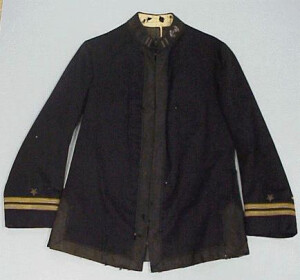 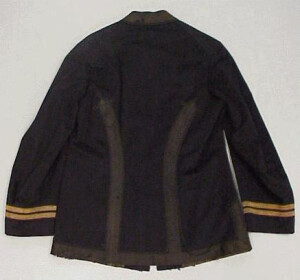 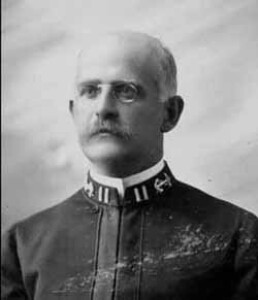 | SHORT DESCRIPTION: Officer's service dress blue tunic, Lieutenant insignia. Worn by Lt. George Preston Blow. NOTES: In the attached photograph from the Naval History and Heritage Command Blow appears to be wearing this uniform. NOTES: George Preston Blow was born in Norfolk, Virginia in 1860. He was enrolled in the United States Naval Academy at the age of 15 (one of the first southerners allowed to matriculate after the Civil War) and graduated in 1881. Shortly after his graduation he was a member of the volunteer crew of the USS Pinta on its controversial trip from Norfolk to Alaska via Cape Horn in 1883. He later served on the USS Pensacola under Captain George Dewey in the Mediterranean. In 1887 he was appointed navigation officer for the attempts to raise the DeBraak in Delaware Bay. In 1890 as aide to Admiral Brown, he was detailed to King Kalakaua of Hawaii during the king's fatal visit to California and was later knighted by Queen Liliuokalani (although he was not authorized by Congress to accept the honor until March, 1887. The decoration was forwarded to him by the Navy Department, and was lost on the USS Maine along with everything else he had on board.) He was assigned as a Lieutenant to the USS Texas in 1895 and USS Maine in 1896 at the age of 36. After surviving the explosion of the Maine on February 15, 1898 he served (during the Spanish American War) as a Commander and later Captain. He was in command of the USS Potomac which assisted in raising the Spanish flagship Infanta Maria Theresa, sunk in the battle of Santiago Bay, and later commanded the USS Vulcan, which was towing the Spanish warship to the United States when it was lost in a gale near Cat Island in the Bahamas. During his naval career he also established the U.S. Hydrographic bureaus in Cleveland and Chicago and was credited with inventing several naval devices including the depth-charge. He died in Washington, D.C. in 1922. | CL27970 | |||||||
| 18 | 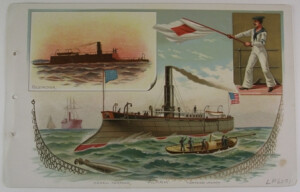 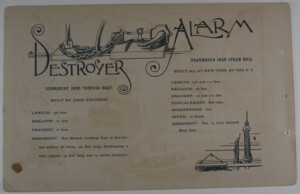 | SHORT DESCRIPTION: Print from album "Our Navy" featuring a grouping of images of the Destroyer, Alarm, Howell Torpedo, a sailor using a signal flag and a Torpedo Launch. On the reverse there is information about each ship. NOTES: This is one page of a bound set of 15 chromolithographs printed by Schumacher & Ettlinger of New York titled "Our Navy." They were printed for Allen & Ginter, cigarette manufacturers in Richmond, Virginia who began selling trading cards with their cigarette packages. This included sports figures, famous Americans, and this example about the U.S. Navy. This set is designated A22 in the American Card Catalog. For the bound set, see VA57 .O92 Rare in the Library. See LP 6281-LP 6295 for the complete series. NOTES: [from paper conservator, Emilie Duncan] I do think they are color lithographs. I think the characteristics Lindsey and I were seeing that were making us hesitate were caused by the way the ink sits on the clay-coated paper surface. I was curious about color lithograph vs. chromolithograph, and it looks like they are indeed the same thing, but chromolithograph is generally used when talking about mass-produced items or ephemera, while color or tinted lithograph is used for fine art pieces. Just thought I would pass that along in case it helps with the cataloging language. NOTES: Print from "Our Navy". A souvenir album produced by Allen & Ginter Tobacco of Richmond, Virginia. The chromolithographs featured in the album were of American naval vessels and were designed solely for this album. They were printed by Schumacher and Ettlinger, New York. The subjects included: Wyoming, Richmond, Baltimore, Vesuvius, The Dynamite Gun, Charleston, Portsmouth, High Power Gun - 6 in Rifle. Newark, San Francisco, Frigate Franklin, Alaska, Yorktown, Constitution "Old Ironsides" Being Towed to Portsmouth NH, Encounter Between Constitution and Guierriere, As Receiving Ship at Portsmouth NH, Admiral Farragut, Colorado, Pinta, Alert, Juanita, Admiral Porter, Chicago, Admiral's Flag, Petrel, Destroyer, Alarm, Howell Torpedo, Signaling, Torpedo Launch, Boston, Wabash, Minnesota, Monitor, Firing of Gatling Gun From Top, Miantonomoh, Atlanta, Armored Battleship Texas, Kearsarge, Armoured Cruiser, Maine. | CL9949 | |||||||
| 19 | 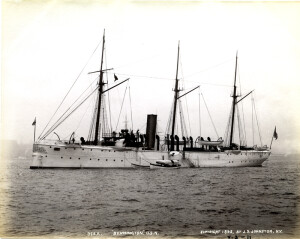 | 1893 | USA; NEW YORK; NEW YORK | cruiser | Ship at dock with launch alongside. USS Bennington (Gunboat # 4), 1891-1910 USS Bennington, last completed of the three 1700-ton Yorktown class gunboats, was built at Chester, Pennsylvania. Commissioned in June 1891, she performed her initial service with the Squadron of Evolution, which cruised to the Caribbean and South America from late 1891 into mid-1892. After a brief assignment to the South Atlantic Squadron, Bennington crossed the Atlantic to southern European waters, where she remained until February 1893, when she accompanied a replica of Christopher Columbus' Pinta on a voyage the Western Hemisphere. The gunboat made a second deployment to the Mediterranean area between August 1893 and February 1904. She then went to the Pacific, by way of Cape Horn. Bennington operated along the west coasts of North and South America, with occasional trips to Hawaii, for more than four years. Her Spanish-American War activities were limited to guarding U.S. interests in Hawaii and along the coast of California. In September 1898 she began her only deployment to the Far East. En route to that area she took possession of Wake, a remote atoll that is still U.S. territory. While in the western Pacific, Bennington took part in operations to supress insurrection in the Philippines, as well as visiting Japan and China. She returned to the U.S. West Coast in August 1901 and was soon decommissioned. Following a shipyard overhaul, Bennington was recommissioned in early March 1903 to begin another tour of duty with the Pacific Squadron. This assignment largely involved operations off the western shores of the Americas, ranging from Alaska to South America. She also went to Hawaii in mid-1904 and in the spring and early summer of 1905. On 21 July 1905, a few days after returning to mainland, Bennington was preparing to leave San Diego, California, when she suffered a violent boiler explosion. More than sixty of her officers and men lost their lives in this tragedy, which left the ship beached and partially sunk. Refloated and towed to the Mare Island Navy Yard, in San Francisco Bay, she was placed out of commission at the end of October 1905. The badly damaged, and now relatively elderly Bennington was not repaired and, after five years of inactivity, was sold in November 1910. Her new owners converted her to a barge and took her to Hawaii, where she was employed until scuttled at sea in the mid-1920s. | P0001.014/02-APN03#011 | ||||
| 20 | 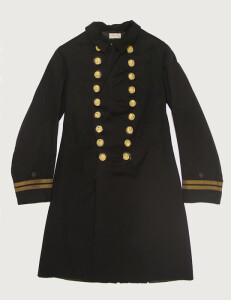 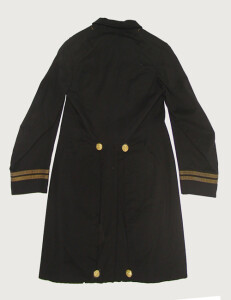 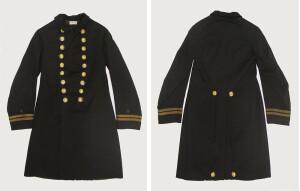 | NOTES: George Preston Blow was born in Norfolk, Virginia in 1860. He was enrolled in the United States Naval Academy at the age of 15 (one of the first southerners allowed to matriculate after the Civil War) and graduated in 1881. Shortly after his graduation he was a member of the volunteer crew of the USS Pinta on its controversial trip from Norfolk to Alaska via Cape Horn in 1883. He later served on the USS Pensacola under Captain George Dewey in the Mediterranean. In 1887 he was appointed navigation officer for the attempts to raise the DeBraak in Delaware Bay. In 1890 as aide to Admiral Brown, he was detailed to King Kalakaua of Hawaii during the king's fatal visit to California and was later knighted by Queen Liliuokalani (although he was not authorized by Congress to accept the honor until March, 1887. The decoration was forwarded to him by the Navy Department, and was lost on the USS Maine along with everything else he had on board.) He was assigned as a Lieutenant to the USS Texas in 1895 and USS Maine in 1896 at the age of 36. After surviving the explosion of the Maine on February 15, 1898 he served (during the Spanish American War) as a Commander and later Captain. He was in command of the USS Potomac which assisted in raising the Spanish flagship Infanta Maria Theresa, sunk in the battle of Santiago Bay, and later commanded the USS Vulcan, which was towing the Spanish warship to the United States when it was lost in a gale near Cat Island in the Bahamas. During his naval career he also established the U.S. Hydrographic bureaus in Cleveland and Chicago and was credited with inventing several naval devices including the depth-charge. He died in Washington, D.C. in 1922. | CL27967 | |||||||
| 21 | No image URL. | SHORT DESCRIPTION: This flag briefly flew over two captured Spanish vessels during the Spanish American War (the gunboat SANDOVAL and Admiral Pascual Cervera's flagship INFANTA MARIA TERESA.) In both instances, the flag was hoisted by the tugboat U.S.S. POTOMAC which assisted in the raising and towing of the two vessels. The U.S.S. POTOMAC was commanded by Lt. George Preston Blow. NOTES: George Preston Blow was born in Norfolk, Virginia in 1860. He was enrolled in the United States Naval Academy at the age of 15 (one of the first southerners allowed to matriculate after the Civil War) and graduated in 1881. Shortly after his graduation he was a member of the volunteer crew of the USS Pinta on its controversial trip from Norfolk to Alaska via Cape Horn in 1883. He later served on the USS Pensacola under Captain George Dewey in the Mediterranean. In 1887 he was appointed navigation officer for the attempts to raise the DeBraak in Delaware Bay. In 1890 as aide to Admiral Brown, he was detailed to King Kalakaua of Hawaii during the king's fatal visit to California and was later knighted by Queen Liliuokalani (although he was not authorized by Congress to accept the honor until March, 1887. The decoration was forwarded to him by the Navy Department, and was lost on the USS Maine along with everything else he had on board.) He was assigned as a Lieutenant to the USS Texas in 1895 and USS Maine in 1896 at the age of 36. After surviving the explosion of the Maine on February 15, 1898 he served (during the Spanish American War) as a Commander and later Captain. He was in command of the USS Potomac which assisted in raising the Spanish flagship Infanta Maria Theresa, sunk in the battle of Santiago Bay, and later commanded the USS Vulcan, which was towing the Spanish warship to the United States when it was lost in a gale near Cat Island in the Bahamas. During his naval career he also established the U.S. Hydrographic bureaus in Cleveland and Chicago and was credited with inventing several naval devices including the depth-charge. He died in Washington, D.C. in 1922. NOTES: David Dick, 8/16/2002 The story of the flag from the INFANTA MARIA THERESA is fairly well covered in the Naval History article. I have underlined in red pencil the sequence of events. The summation is: During the Spanish American War, circa, June 1898, five Spanish vessels including the MARIA TERESA were driven ashore in Cuba. The status of these beached vessels was found that the MARIA THERESA was salvageable. On September 23rd, 1898, the vessel was towed off the beach and was made ready for towing to Norfolk for further repairs and modification for future use by the navy. The U.S. flag was run up the mast and the vessel was renamed TERESA. It ship was never commissioned by the Navy. On October 29, 1898, the three boats towed (MERRITT, VULCAN and TERESA) left for Norfolk. From the start, the weather was fairly windy but the convoy managed. However, on November 1, 1898, the convoy was hit by a tropical storm. Finally it was necessary to cut the vessels from the tow, at this high pitch of the storm, it was noted that the U.S. flag was still flying. The TERESA ended up on Cat Island, Bahamas. According to the naval history article, it is still there. VESSEL INFORMATION - VESSEL NAME: INFANTA MARIA TERESA VESSEL TYPE: Cruiser VESSEL LAID DOWN: 1889 VESSEL LAUNCHED: 1890 COMPLETED: 1893 SHIPBUILDER: SOCIEDAD ASTILLEROS DEL NERVION BUILDER LOCATION: BILBAO, SPAIN VESSEL HISTORY: She was a modern and speedy first class cruiser. However, the level of training and maintenance in the Spanish fleet was not what it should have been, and the TERESA, like all of Cervara's ships, went to war at less than full efficiency. She was in need of dry-docking and short of ammunition. Even some of her guns were not opera table. Also, like all warships of the era, she was heavily decorated and furnished with wood. The US Navy stripped this flammable material off its vessels at the beginning of the conflict, but the Spanish failed to do so, making the Teresa and her fleet-mates seriously susceptible to fire. ADDITIONAL INFORMATION: See "Maine, A Ship to Remember, by Michael Blow and Naval History, February 2002 issue, page 26 (for article see object file). | CL28631 | |||||||
| 22 | 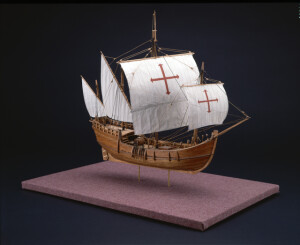 | SHORT DESCRIPTION: Four-masted caravel (two square, two lateen rigged) with sails set full. Hull has caravel planking, caulked below deck level, curved stem, straight sternpost with hung rudder, transom stern. Fitted with bowsprit, one anchor, one pump, one water cask, two hatches, two ladders, four falconets (swivel guns) on poop rail. Mounted on two brass rods driven into hull. NOTES: Based on Martinez-Hidalgo drawings for hull; research published in National Geographic, November 1986, indicating this as the probable rig for NINA; Roger Hambidge had built the larger model, shown in that article, for National Geographic Society, and research data was made available for the Museum model by courtesy of the Society. VESSEL INFORMATION- VESSEL NAME: NINA ALL NAMES OF VESSEL: 1) NINA, 2) SANTA CLARA NATIONALITY: SPANISH HOME PORT: SPAIN, PALOS VESSEL TYPE: CARAVELA REDONDA (square rigged caravel) VESSEL DIMENSIONS: 67' LENGTH X 21' BEAM X 7' DRAFT (APPROX.); 58-60 TONS CAPACITY SERVICE DATES: PRE-1492 TO 1499 OR LATER SHIPBUILDER LOCATION: SPAIN, MOGUER SHIP OWNERS: NINO, JUAN (OWNER AND MASTER) CAPTAINS OR OTHER RELATED PEOPLE: Vincente Yáñez Pinzón (CAPTAIN); COLUMBUS, CHRISTOPHER (ADMIRAL) MAJOR EVENTS: COLUMBUS' VOYAGES OF DISCOVERY, 1492-1499 RELATED VESSELS: SANTA MARIA, PINTA (other vessels in Columbus' fleet, 1492-1493) | CL21542 | |||||||
| 23 | 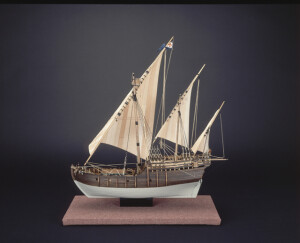 | SHORT DESCRIPTION: Model with dark stained topside, warm gray bottom, planked over hull solid to main deck. Tall main mast, amidship, two smaller masts aft, all rigged and set with lateen sails. Main deck furnished under raised poop. Equipment includes two lantakas, pumps, galley, barrels, spare spar, boat inverted on hatch, windlass, two anchors, sounding box. Supported by two bolts through single pedestal, and red-painted, carved, cross of Bethlehem. MODEL NOTES: Model to represent typical Portuguese caravel from the era of Prince Henry the Navigator, from a composite of sources, including marine archaeology materials from U.S. National Park Service in Albuquerque, N.M., which McKay cites as source of forward deck and bow much lower than usually depicted for such vessels. LABEL COPY: CARAVEL 14th century Model, scale 1/4"=1', 1991 Greg McKay, model maker Museum Collection 91.53 (Dlbl) The Mediterranean caravel was sharper and slimmer than the nao. It was used by Portuguese explorers Diogo Cao and Bartolomeu Dias and by Christopher Columbus. (Age March 21, 1992) VESSEL INFORMATION- VESSEL NAME: (NONE) NATIONALITY: PORTUGUESE VESSEL TYPE: CARAVEL VESSEL DIMENSIONS: SERVICE DATES: EARLY 15TH CENTURY SHIPBUILDER LOCATION: PORTUGAL CAPTAINS OR OTHER RELATED PEOPLE: PRINCE HENRY THE NAVIGATOR, GIL EANES, ALFONSO GONCALVES BALDAIA, VASCO DA GAMA, BARTLOMEO DIAS, CHRISTOPHER COLUMBUS MAJOR EVENTS: EXPLORATIONS VESSEL HISTORY: DATE SCRAPPED, WRECKED, ETC: PLACE OF SCRAPPING, WRECKING, ETC: ASSOCIATED (RELATED?) PLACES: PORTUGAL, SAGRES, CAPE ST. VINCENT; SPAIN, VARIOUS PORTS AND SIMILAR VESSELS RELATED VESSELS: (NINA, PINTA) | CL21544 | |||||||
| 24 | 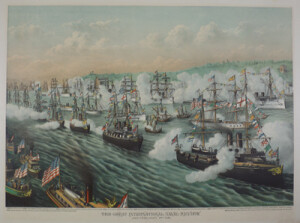 | SHORT DESCRIPTION: Appearing in the print are replicas of the SANTA MARIA, NINA and PINTA built in 1893, which were respectively towed over from Spain by the REGINA REGENTE, USS NEWARK and USS BENNINGTON. These boats were later exhibited at the Chicago Columbian exposition. VESSEL INFORMATION - VESSEL NAME: USS DOLPHIN VESSEL TYPE: Dispatch Boat, Patrol Gunboat LAUNCHED: April 12, 1884 COMMISSIONED: December 8, 1885 SERVICE DATES: 1885-ca 1927 DISPOSAL DATE: 1922 SHIPBUILDER: John Roach & Sons BUILDER LOCATION: Chester, Pennsylvania SHIP OWNER: US Navy (1884-1922); Mexican Navy (1922-ca 1927) VESSEL HISTORY: USS Dolphin (PG-24) was launched April 12, 1884 by John Roach & Sons of Chester, PA. She was part of the New Navy, the new steel ships (rather than iron) built for the U.S. Navy. She was stationed with the North Atlantic Station and the Squadron of Evolution. She carried the Secretary of the Navy, the President, and attended various celebrations. Dolphin participated in the blockade of Havana in April and May of 1898, then moved to Santiago where the ship came under fire from Castillo de San Pedro de la Roca (see 1998.33.26) on June 6. Dolphin returned to Norfolk July 2, 1898. Dolphin remained in the Caribbean throughout WWI, and was eventually sold to Mexico in 1922. The ship’s name became the Plan de Guadalupe, and she was scrapped around 1927. MAJOR EVENTS: Spanish-American War, WWI ALTERNATE VESSEL NAMES: USS Dolphin (1884-1922); Plan de Guadalupe (1922-ca 1927) DISPOSAL DATE: ca 1927 | CL18429 | |||||||
| 25 | 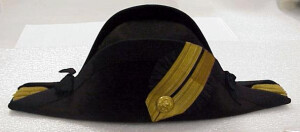 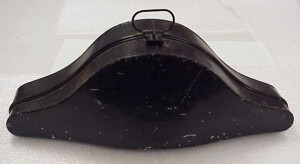 | NOTES: George Preston Blow was born in Norfolk, Virginia in 1860. He was enrolled in the United States Naval Academy at the age of 15 (one of the first southerners allowed to matriculate after the Civil War) and graduated in 1881. Shortly after his graduation he was a member of the volunteer crew of the USS Pinta on its controversial trip from Norfolk to Alaska via Cape Horn in 1883. He later served on the USS Pensacola under Captain George Dewey in the Mediterranean. In 1887 he was appointed navigation officer for the attempts to raise the DeBraak in Delaware Bay. In 1890 as aide to Admiral Brown, he was detailed to King Kalakaua of Hawaii during the king's fatal visit to California and was later knighted by Queen Liliuokalani (although he was not authorized by Congress to accept the honor until March, 1887. The decoration was forwarded to him by the Navy Department, and was lost on the USS Maine along with everything else he had on board.) He was assigned as a Lieutenant to the USS Texas in 1895 and USS Maine in 1896 at the age of 36. After surviving the explosion of the Maine on February 15, 1898 he served (during the Spanish American War) as a Commander and later Captain. He was in command of the USS Potomac which assisted in raising the Spanish flagship Infanta Maria Theresa, sunk in the battle of Santiago Bay, and later commanded the USS Vulcan, which was towing the Spanish warship to the United States when it was lost in a gale near Cat Island in the Bahamas. During his naval career he also established the U.S. Hydrographic bureaus in Cleveland and Chicago and was credited with inventing several naval devices including the depth-charge. He died in Washington, D.C. in 1922. INVENTORY: hat case - there is one (1) component part. | CL27969 | |||||||
| 26 | 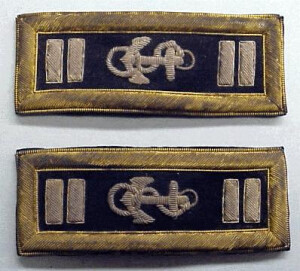 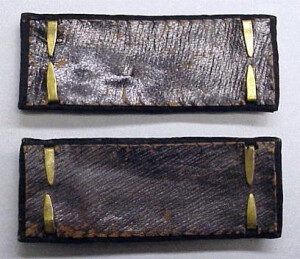 | NOTES: George Preston Blow was born in Norfolk, Virginia in 1860. He was enrolled in the United States Naval Academy at the age of 15 (one of the first southerners allowed to matriculate after the Civil War) and graduated in 1881. Shortly after his graduation he was a member of the volunteer crew of the USS Pinta on its controversial trip from Norfolk to Alaska via Cape Horn in 1883. He later served on the USS Pensacola under Captain George Dewey in the Mediterranean. In 1887 he was appointed navigation officer for the attempts to raise the DeBraak in Delaware Bay. In 1890 as aide to Admiral Brown, he was detailed to King Kalakaua of Hawaii during the king's fatal visit to California and was later knighted by Queen Liliuokalani (although he was not authorized by Congress to accept the honor until March, 1887. The decoration was forwarded to him by the Navy Department, and was lost on the USS Maine along with everything else he had on board.) He was assigned as a Lieutenant to the USS Texas in 1895 and USS Maine in 1896 at the age of 36. After surviving the explosion of the Maine on February 15, 1898 he served (during the Spanish American War) as a Commander and later Captain. He was in command of the USS Potomac which assisted in raising the Spanish flagship Infanta Maria Theresa, sunk in the battle of Santiago Bay, and later commanded the USS Vulcan, which was towing the Spanish warship to the United States when it was lost in a gale near Cat Island in the Bahamas. During his naval career he also established the U.S. Hydrographic bureaus in Cleveland and Chicago and was credited with inventing several naval devices including the depth-charge. He died in Washington, D.C. in 1922. INVENTORY: two epaulet - there are two (2) component parts. | CL27971 | |||||||
| 27 | 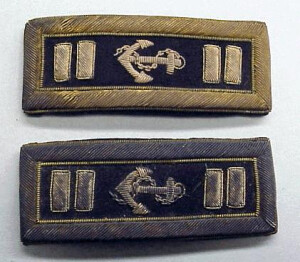 | NOTES: George Preston Blow was born in Norfolk, Virginia in 1860. He was enrolled in the United States Naval Academy at the age of 15 (one of the first southerners allowed to matriculate after the Civil War) and graduated in 1881. Shortly after his graduation he was a member of the volunteer crew of the USS Pinta on its controversial trip from Norfolk to Alaska via Cape Horn in 1883. He later served on the USS Pensacola under Captain George Dewey in the Mediterranean. In 1887 he was appointed navigation officer for the attempts to raise the DeBraak in Delaware Bay. In 1890 as aide to Admiral Brown, he was detailed to King Kalakaua of Hawaii during the king's fatal visit to California and was later knighted by Queen Liliuokalani (although he was not authorized by Congress to accept the honor until March, 1887. The decoration was forwarded to him by the Navy Department, and was lost on the USS Maine along with everything else he had on board.) He was assigned as a Lieutenant to the USS Texas in 1895 and USS Maine in 1896 at the age of 36. After surviving the explosion of the Maine on February 15, 1898 he served (during the Spanish American War) as a Commander and later Captain. He was in command of the USS Potomac which assisted in raising the Spanish flagship Infanta Maria Theresa, sunk in the battle of Santiago Bay, and later commanded the USS Vulcan, which was towing the Spanish warship to the United States when it was lost in a gale near Cat Island in the Bahamas. During his naval career he also established the U.S. Hydrographic bureaus in Cleveland and Chicago and was credited with inventing several naval devices including the depth-charge. He died in Washington, D.C. in 1922. INVENTORY: two epaulet - there are two (2) component parts. | CL27972 | |||||||
| 28 | 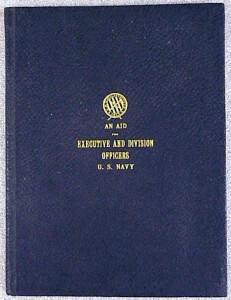 | NOTES: This manual of blank forms was purchased and owned by Lt. George Preston Blow but was never used. NOTES: George Preston Blow was born in Norfolk, Virginia in 1860. He was enrolled in the United States Naval Academy at the age of 15 (one of the first southerners allowed to matriculate after the Civil War) and graduated in 1881. Shortly after his graduation he was a member of the volunteer crew of the USS Pinta on its controversial trip from Norfolk to Alaska via Cape Horn in 1883. He later served on the USS Pensacola under Captain George Dewey in the Mediterranean. In 1887 he was appointed navigation officer for the attempts to raise the DeBraak in Delaware Bay. In 1890 as aide to Admiral Brown, he was detailed to King Kalakaua of Hawaii during the king's fatal visit to California and was later knighted by Queen Liliuokalani (although he was not authorized by Congress to accept the honor until March, 1887. The decoration was forwarded to him by the Navy Department, and was lost on the USS Maine along with everything else he had on board.) He was assigned as a Lieutenant to the USS Texas in 1895 and USS Maine in 1896 at the age of 36. After surviving the explosion of the Maine on February 15, 1898 he served (during the Spanish American War) as a Commander and later Captain. He was in command of the USS Potomac which assisted in raising the Spanish flagship Infanta Maria Theresa, sunk in the battle of Santiago Bay, and later commanded the USS Vulcan, which was towing the Spanish warship to the United States when it was lost in a gale near Cat Island in the Bahamas. During his naval career he also established the U.S. Hydrographic bureaus in Cleveland and Chicago and was credited with inventing several naval devices including the depth-charge. He died in Washington, D.C. in 1922. | CL28158 | |||||||
| 29 | 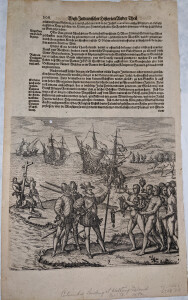 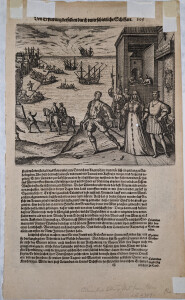 | SHORT DESCRIPTION: Pages 205 and 206 from Johann Gottfried's 1655 publication 'Newe Welt Und Americanische Historien.' Page 205 shows an image of explorer Christopher Columbus meeting with Queen Isabella and King Ferdinand in Palos, Spain prior to leaving on his first voyage in 1492. Page 206 shows an image of Columbus meeting the native Lucayans after landing on the island of Guanahani in the Bahamas on October 12, 1492. On page 205 Columbus is shown at the bottom center. He appears to be turning away to leave while looking over his left shoulder back at Queen Isabella and King Ferdinand. A hanging banner with the coat of arms of Spain behind them. Two guards with pole arms stand behind the Queen’s right shoulder. Behind the guards three men sit at a table in a building, they appear to be counting coins. Behind Columbus two men ride horses on the beach. Behind them troops appear to be embarking in small boats and rowing out to three vessels anchored in the bay behind Columbus. The walled town is at the extreme left in the background. One page 206 Columbus is shown standing at the bottom center holding a pike. Two musketeers stand behind him to the left. The native Lucayans are shown at the right presenting Columbus with jeweled necklaces and other treasures. In the middle ground at the left three men are planting a cross on a point of land. In the extreme background are Columbus’s ships (Santa Maria, Nina and Pinta). The Santa Maria is anchored near the shoreline and men are disembarking in small boats and are landing on the beach. NOTES: The native Lucayan people called the island Guanahani Columbus named the island San Salvador. According to National Geographic: “The modern identity of Guanahani remains a subject of historical debate, and over the years, multiple Bahamian islands have been suggested as candidates for “Guanahani”, including Sanama Cay, Rum Cay, Grand Turk Island, and the Plana Cays. However, the most popular theory is that Guanahani is the island today known as San Salvador (which was known as Watling Island until its name was officially changed to San Salvador in 1925 to recognize it as the site of Columbus’ first landing).” NOTES: From: Newe Welt Und Americanische Historien : Inhaltende Warhafftige und vollkommene Beschreibungen Aller West-Indianischen Landschafften/ Insulen/ Königreichen und Provintzien/ Seecusten/ fliessenden [...] / ... zusam[m]en getragen/ ... Durch Johann Ludwig Gottfriedt. Mit zugehörigen Landtafeln ... und ... Kupfferstücken ... gezieret und verlegt/ Durch Mattheum Merian/ ... Franckfurt : Meriansche Erben, 1655 In the section: West-Indianischer Historien Ander Theil/ Von Erfindung derselben durch underschiedliche Schiffarthen. In the "chapter": Die erste Schiffart und Entdeckung der Newen Welt/ durch Christophorum Columbum von Genua. Anno Christi 1492. Images on pages: 205 and 206 NOTES: This engraving comes from Johann Ludwig Gottfried's abridgment of Theodor de Bry titled Newe Welt und Americanische Historien [published in 1655]. Little is known about the German publisher Johann Ludwig Gottfried (c. 1584-1633), who inherited Theodor De Bry’s (1528-1598) publishing firm. Gottfried studied theology in Heidelberg. As of 1603 he was active as deacon, afterwards as reformed priest in villages in the Electoral Palatinate's left side of the Rhine. Between 1625 and 1633 he was active in Offenbach. Owing to his talent for languages and his education in general, he became a highly esteemed assistant of Frankfurt publishers like Johann Theodor de Bry, de Bry's nephew Lucas Jennis and de Bry's son in law Matthäus Merian the Elder as of 1619. He made translations, epigrams, paraphrases and compilations for many distinguished publications. Between 1590 and 1634, de Bry and his sons issued thirteen volumes containing illustrated accounts of the expeditions of Magellan, Columbus, Vespucci, Cortes, Balboa, Raleigh, Drake, Smith, and many others. In most cases, theirs were the first images ever made of the Americas by Europeans. In 1631 Gottfried, who had worked on the volumes and inherited the de Bry family publishing firm, issued together with Matthaeus Merian (publisher, artist & engraver) a one-volume condensation "Newe Welt Vnd Americanische Historien/ Jnhaltende Warhafftige vnd volkommene Beschreibungen Aller West-Indianischen Landschafften..." that used many of the original copper plates and supplemented them with new ones of more recent voyages." The first edition of the abridgment was published by Matthaeus Merian in 1631. It was reprinted in 1655. | CL16764 | |||||||
| 30 | 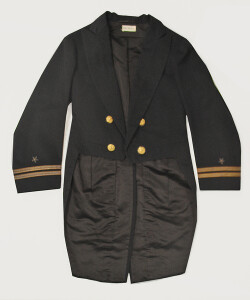 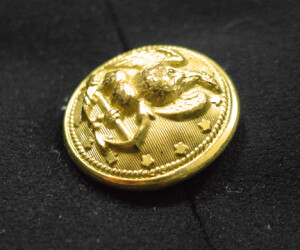 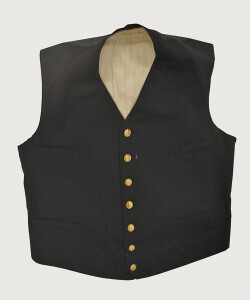 | SHORT DESCRIPTION: U.S. Navy officer's evening dress blue coat and waistcoat. NOTES: George Preston Blow was born in Norfolk, Virginia in 1860. He was enrolled in the United States Naval Academy at the age of 15 (one of the first southerners allowed to matriculate after the Civil War) and graduated in 1881. Shortly after his graduation he was a member of the volunteer crew of the USS Pinta on its controversial trip from Norfolk to Alaska via Cape Horn in 1883. He later served on the USS Pensacola under Captain George Dewey in the Mediterranean. In 1887 he was appointed navigation officer for the attempts to raise the DeBraak in Delaware Bay. In 1890 as aide to Admiral Brown, he was detailed to King Kalakaua of Hawaii during the king's fatal visit to California and was later knighted by Queen Liliuokalani (although he was not authorized by Congress to accept the honor until March, 1887. The decoration was forwarded to him by the Navy Department, and was lost on the USS Maine along with everything else he had on board.) He was assigned as a Lieutenant to the USS Texas in 1895 and USS Maine in 1896 at the age of 36. After surviving the explosion of the Maine on February 15, 1898 he served (during the Spanish American War) as a Commander and later Captain. He was in command of the USS Potomac which assisted in raising the Spanish flagship Infanta Maria Theresa, sunk in the battle of Santiago Bay, and later commanded the USS Vulcan, which was towing the Spanish warship to the United States when it was lost in a gale near Cat Island in the Bahamas. During his naval career he also established the U.S. Hydrographic bureaus in Cleveland and Chicago and was credited with inventing several naval devices including the depth-charge. He died in Washington, D.C. in 1922. INVENTORY: dress coat and vest - there are two (2) component parts. VESSEL INFORMATION-- VESSEL NAME: Maine SERVICE DATES: 1888-1898 DATE WRECKED: February 15, 1898 SHIP BUILDER: U.S. Navy Yard SHIP LINE: U.S. Navy BUILDER LOCATION: New York, New York VESSEL HISTORY: Blown up in Havana Harbor, Cuba, February 15, 1898. Wreck later raised and towed to sea where it was sunk on March 16, 1912. MAJOR EVENT: Spanish-American War CAPTAINS OR OTHER RELATED PEOPLE: SHIP OWNERS: U.S. Navy ENGING BUILDER AND LOCATION: VESSEL DIMENSIONS: 6682 tons; 318' x 27' x 216' | CL27968 | |||||||
| 31 | 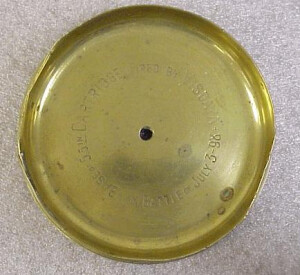 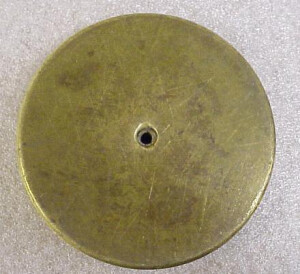 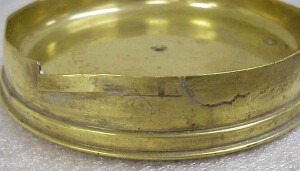 | NOTES: Cartridge base was supposedly recovered by Lt. George Preston Blow a division officer aboard the U.S.S. MAINE who, following the destruction of the MAINE, went on to serve in the American squadron blockading Cuba in the summer of 1898. NOTES: George Preston Blow was born in Norfolk, Virginia in 1860. He was enrolled in the United States Naval Academy at the age of 15 (one of the first southerners allowed to matriculate after the Civil War) and graduated in 1881. Shortly after his graduation he was a member of the volunteer crew of the USS Pinta on its controversial trip from Norfolk to Alaska via Cape Horn in 1883. He later served on the USS Pensacola under Captain George Dewey in the Mediterranean. In 1887 he was appointed navigation officer for the attempts to raise the DeBraak in Delaware Bay. In 1890 as aide to Admiral Brown, he was detailed to King Kalakaua of Hawaii during the king's fatal visit to California and was later knighted by Queen Liliuokalani (although he was not authorized by Congress to accept the honor until March, 1887. The decoration was forwarded to him by the Navy Department, and was lost on the USS Maine along with everything else he had on board.) He was assigned as a Lieutenant to the USS Texas in 1895 and USS Maine in 1896 at the age of 36. After surviving the explosion of the Maine on February 15, 1898 he served (during the Spanish American War) as a Commander and later Captain. He was in command of the USS Potomac which assisted in raising the Spanish flagship Infanta Maria Theresa, sunk in the battle of Santiago Bay, and later commanded the USS Vulcan, which was towing the Spanish warship to the United States when it was lost in a gale near Cat Island in the Bahamas. During his naval career he also established the U.S. Hydrographic bureaus in Cleveland and Chicago and was credited with inventing several naval devices including the depth-charge. He died in Washington, D.C. in 1922. VESSEL INFORMATION - VESSEL NAME: VIZCAYA VESSEL TYPE: Infanta Maria Teresa-class armored cruiser BUILDER LOCATION: SPAIN, BILBAO BUILD DATE: 1890-1891 SHIPOWNER: SPANISH NAVY VESSEL DIMENSIONS: 7000 tons, 340 x 65 x 21.6 FATE: Sunk at the Battle of Santiago, July 3, 1898. VESSEL HISTORY: Vizcaya was an armored cruiser of the Spanish Navy that fought at the Battle of Santiago de Cuba during the Spanish-American War. She was laid down in 1889, launched on 8 July 1891, and completed in 1893. | CL28119 | |||||||
| 32 | 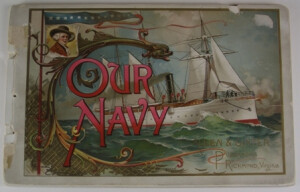 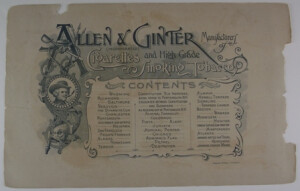 | SHORT DESCRIPTION: The chromolithograph shows USS Dolphin at sea, with sailors on the deck. The left side has a fancy lattice with a sea creature's head, a flag, and the image of the "Old Planter," a character that identified the Allen & Ginter cigarette company. The reverse has a list of all of the lithographs included in this publication. NOTES: This is the cover page to a set of 14 chromolithographs printed by Schumacher & Ettlinger of New York titled, "Our Navy." Allen & Ginter were cigarette manufacturers in Richmond, Virginia who began selling trading cards with their cigarette packages. This included sports figures, famous Americans, and this example about the U.S. Navy. This set is designated A22 in the American Card Catalog. For the bound set, see VA57 .O92 Rare in the Library. See LP 6281-LP 6295 for the complete series. NOTES: [from paper conservator, Emilie Duncan] I do think they are color lithographs. I think the characteristics Lindsey and I were seeing that were making us hesitate were caused by the way the ink sits on the clay-coated paper surface. I was curious about color lithograph vs. chromolithograph, and it looks like they are indeed the same thing, but chromolithograph is generally used when talking about mass-produced items or ephemera, while color or tinted lithograph is used for fine art pieces. Just thought I would pass that along in case it helps with the cataloging language. VESSEL INFORMATION - VESSEL NAME: DOLPHIN VESSEL BUILT: 1883-1884 SHIPBUILDER: JOHN ROACH & SONS BUILDER LOCATION: CHESTER, PENNSYLVANIA VESSEL DIMENSIONS: 1486 tons, 240 x 32 x 14.1 | CL9939 | |||||||
| 33 | 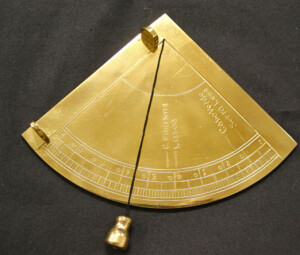 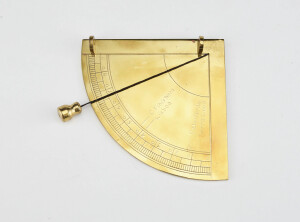 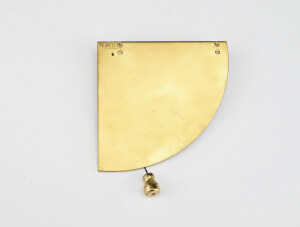 | SHORT DESCRIPTION: Scale on brass 0 to 90 in whole degrees. Peep sights and turned brass plumb bob. Engraved with the altitude of Polaris at Serra Leoa, Cabo Verde, Lisboa and C. Finisterra. Walnut stand. See Peter Ifland, From Taking the Stars. (Newport News, 1998), p.5. ADDITIONAL INFORMATION: Text of brochure that accompanies instrument: The Mariners' Quadrant, The Mariner's Quadrant is one of the oldest and simplest instruments for measuring the altitude of stars. It was widely used by the Portuguese navigators in Columbus' time. On leaving port the navigator would measure the altitude of Polaris using his quadrant. To return home he would sail north or south until Polaris was at the same altitude measured when he left port. At that point, he simply sailed east or west keeping the altitude of Polaris constant until he reached home. He would frequently mark the altitude of Polaris on his quadrant at home port or at any port to which he might wish to return. The quadrant illustrated here is marked with the altitude of Polaris at several of the ports Columbus frequently visited--Cape Verde and Sierra Leone along the coast of Africa and Finisterra and Lisbon on the Portuguese coast. The quadrant shows a reading on the scale of 24 degrees [in the illustration]. This is the altitude of Polaris that Columbus would have observed on the morning of October 12, 1492 at his first sight of land in the New World, now believed to be Watling Island in the Bahamas. Text of article that accompanied instrument: Christopher Columbus, How He Got There and Back: Many foolish sailors and fishermen sailed off into the unknown sea and never found their way back to home port. The smart navigators like Christopher Columbus and Vasco de Gama used the simple techniquest of navigation by the sun and stars to bring them and their ships safely home. The oldest trick of determining latitude, the north-south position on the Earth's surface, is to measure the angle of Polaris, the North Star, above the horizon. This technique was developed hundreds of years before Columbus' time by Arab and Persian sailors traveling along the coast of India and the east coast of Africa. They wuold measure the angle of Polaris above the horizon using a simple instrument made of string and a stick. To return to port after a long voyage, they sailed north or south until Polaris was at the height they measured when they left home. They then turned left or right, keeping Polaris at a constant height, and sailed along until they reached home port. By 1492, the instruments for measuring the altitude of Polaris were much more sophisticated. The quadrant, the cross staff, and the mariner's astrolabe were popular among the Portuguese navigators. The technique of determining latitude by the noon observation of the sun was just coming into use. The determination of longitude, the east-west position on the Earth, came three hundred years later with the development of accurate, sea-going clocks. Some of the very old instruments, such as those used by Christopher Columbus, are in national museums and are too rare and expensive for private collectors. Nautica Instrument Company was established to produce museum quality replicas in limited editions of some of these instruments of special historic significance. Peter Ifland, November, 1991. Text of article that accompanied instrument: Christopher Columbus, The Story of his First Voyage To The New World: It is not surprising that Cristoforo Colombo should lead a life of exploration and adventure on the sea. Genoa, Italy, where he was born in 1451, was a thriving sea port--a hub of prosperous commerce throughout the Mediterranean. While still in his early teens, he when to sea on the ships that brought wool and wine to supply his father's businesses. At age 20, he commanded a Genoese galley ship fighting against the pirates of Tunis who were threatening merchant ships sailing back and forth across the Mediterranean. In May, 1476, young Columbus sailed on a Genoese convoy headed to Flanders and England. In one of those minor events that ultimately shaped history, the convoy was attacked by French pirates as it rounded the coast of Portugal. Columbus' ship was sunk and he had to swim for shore. He landed at Lagos and made his way to Lisbon where there was a well established community of Genoese merchants. Columbus settled in Lisbon where he continued his life as a merchant and mariner. It was an exciting time in Portugal. The country, with enthusiastic support from the King, was caught up in an unparalleled period of exploration and discovery. During this time Columbus made many voyages with the Portuguese seamen. He sailed as far North as Ireland and Iceland and as far south down the west coast of Africa as Sierra Leone. Contrary to modern tales, it was already broadly accepted in Columbus' time that the earth was round. The question of the times was what was the diameter of the earth and how far west of Europe was China, India and the Orient. Columbus grossly underestimated the size of the Earth. He calculated that Japan was 2,400 miles west of the Canary Islands when, in fact, Japan is 10,600 miles west of the Canaries! Columbus proposed his "Enterprise of the Indies" to King John II of Portugal in 1784. This plan, outlining a voyage westward to establish a trade route to China, was rejected by the King's Maritime Commission as impractical. Columbus left Portugal in 1484, moved to Spain and petitioned King Ferdinand and Queen Isabella to support his plan. The Spanish monarchs were preoccupied with a war to drive the Moors out of Granada. It wasn't until January of 1492 when the Moors were defeated that the royal attention could turn to less pressing matters such as Columbus' proposal. Columbus had given upon the Spanish and was on a mule headed for France when Isabella's messenger caught up with him to tell him his plan would receive royal support. Isabella provided about $14,000 from the Royal Police Force treasury to fund the project. The Nina and Pinta were provided by the port of Palos on the South coast of Spain, just outside the gates of Gibraltar. Use of the two ships was in payment of a fine imposed by the Crown. Columbus chartered the Santa Maria from a private owner to use as his flagship. The three ships carried a total of 90 men, mostly professional seamen. The fleet sailed from Palos early on the morning of Friday, August 3rd, 1492. After a stopover for a few days in the Canaries, which Columbus thought was about the latitude of Japan, they set sail on a westerly course on September 6th. The favorable winds blowing steadily out of the East at these latitudes pushed the ships briskly across the open ocean, so much that the crew became concerned that they would not be able to find a favorable wind to carry them back home. On the 7th of October, Columbus changed course slight to the southwest and five days later, early on the morning of October 12th, land was sighted. The best estimate is that the first landing in the New World was on the island now known as Watling Island in the Bahamas. He named this island San Salvador. Columbus was convinced that he has sailed past Japan and that China was only a few days sail further west. He sailed to the north west and soon landed in Cuba. So convinced was he that he had landed in Asia that he sent out emissaries with a message of greeting to the Great Kahn, Emperor of China. When the delegations returned empty handed, the fleet set sail eastward. They promptly discovered the large island we now know as Haiti and the Dominican Republic. Columbus named the island Hispanola and claimed it for the King of Spain. The return trip eastward back to Spain was not nearly as easy as the sail westward had been. The Santa Maria was lost on a reef on Christmas Eve, 1492 and the two remaining ships encountered a severe storm in the Azores. Another storm drove them northward past the entrance to the Mediterranean at Gibraltar and on to Lisbon. While in Lisbon, Columbus visited King John who earlier had refused to finance Columbus' explorations. This time, when Columbus told King John what he had found, the King tried to claim the discoveries for Portugal but his claim was ultimately unsuccessful. Columbus returned to Palos on March 14, 1493, more than seven months after he set sail. He traveled overland by cavalcade across Spain to Barcelona. Here he was received by the Royal Court with all the honor and celebration he had so rightfully earned. Columbus made three more voyages to the western Atlantic. It was not until his third voyage, on landing on the mainland of the coast of Brazil, that he wrote in his journal on August 5, 1498: "I believe that this is a very great continent, until today unknown." How right he was! Peter Ifland, 1991. | CL26252 | |||||||
| 34 | 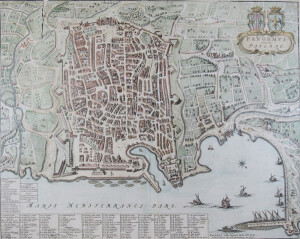 | NOTES: The publication "A List of Geographical Atlases in the Library of Congress" indicates this image was published in Volume three of Pierre Mortier's 1704 edition of Joannes Blaeu's ‘Novum Italiæ theatrum, sive Accurata descriptio ipsius urbium, palatiorum, sacrarum ædium, &c...', however, it is listed as plate 41. In the edition of ‘Novum Italiæ theatrum, sive Accurata description ipsius urbium, palatiorum, sacrarum ædium, &c...’ published by Rutgert Christophle Alberts in The Hague in 1724 it appears as plate 29 in volume three, which matches this image. NOTES: There are 162 references in twelve columns across the bottom of the print. NOTES: [Martha Wyatt, 05/08/2001] This print is from Joan Blaeu, Noveau theatri d'itale…, Amsterdam, 1704 (4 volumes). A member of the famous Dutch publishing family, in 1638 Joan Blaeu was appointed his father, Willem Janszoon Blaeu's, successor in the Hydrographic office of the V.O.C. (United East India Company). His attitude in the promotion of maritime cartography lacked the fervor of his industrious attitude towards geography. He aimed at full description of heaven, earth, and water, which was unachievable, but his efforts did culminate in the magnificent Atlas Major and the town-books of the Netherlands and of Italy (this is what we have). Works unsurpassed in history and in modern times, which gave eternal fame to the name of the Blaeus. In 1667 Joan Blaeu's printing house was moved and it was shortly after this in 1672 that a fire ruined the business. One year late Blaeu died. The fire and the passing of the director gave rise to the sale of the complete stock of the Blaeu House. The remainder of the printing business was handled by Blaeu's on until 1695 when it was sold at auction, bringing to an end to renowned Blaeu printing house. | CL15270 |
Created 2026 by Don Barker, CBMM volunteer, for the Chesapeake Shipbuilding Project. shipbuilding@sailingworkboats.es